Surfacing actionable insights from electronic case reporting data
Summary
Public health departments struggle to sort through incoming electronic case reporting (eCR) data to find what they need for case investigation. As part of the Data Integration Building Blocks (DIBBs) engagement with the Centers for Disease Control and Prevention (CDC) and the U.S. Digital Service (USDS, now U.S. DOGE Service), we built the eCR Viewer. The tool surfaces key information from eCR files, making them more useful for monitoring the spread of reportable conditions.
The challenge
To reduce the burden of manual reporting on healthcare providers, the Association of Public Health Laboratories (APHL), the Council of State and Territorial Epidemiologists (CSTE), and the CDC established an automated reporting channel. It moves case report information from electronic health records (EHRs) to public health departments.
This process, known as eCR, is intended to make disease reporting faster and easier. It replaces manual case reports traditionally sent by mail, phone, and fax. When data corresponding to a reportable condition (e.g., COVID-19) is entered into a patient’s EHR, a case report is automatically generated and sent to the appropriate public health agencies. Agencies can then record, track, and investigate individual cases. The automated approach has the potential to streamline both case ascertainment and case investigation.
Implementation progress continued in 2024, with 53% of jurisdictions now receiving eCR data for at least three-quarters of their reportable conditions. But many public health departments still face barriers to integrating eCR into existing workflows. Each file includes the patient’s entire health record, not just the reportable condition. The volume makes it hard for staff to figure out why the eCR was sent and where it should go next. Adding to the challenge, eCR data is structured for computer-to-computer communication and doesn’t arrive in a format that’s easy for humans to read. Reviewing incoming eCRs takes significant time and effort.
You can just scroll on forever for some of these eCRs and never find what you’re looking for.
Finding critical information from eCR data can feel like looking for a needle in a haystack. Because eCR data is so difficult to sort through, many public health jurisdictions still choose to manually contact healthcare providers for clinical information — a time-consuming and onerous process on both sides. To fulfill the promise of eCR, public health staff need to be able to quickly find key information from incoming data so they can take timely public health action.
The solution
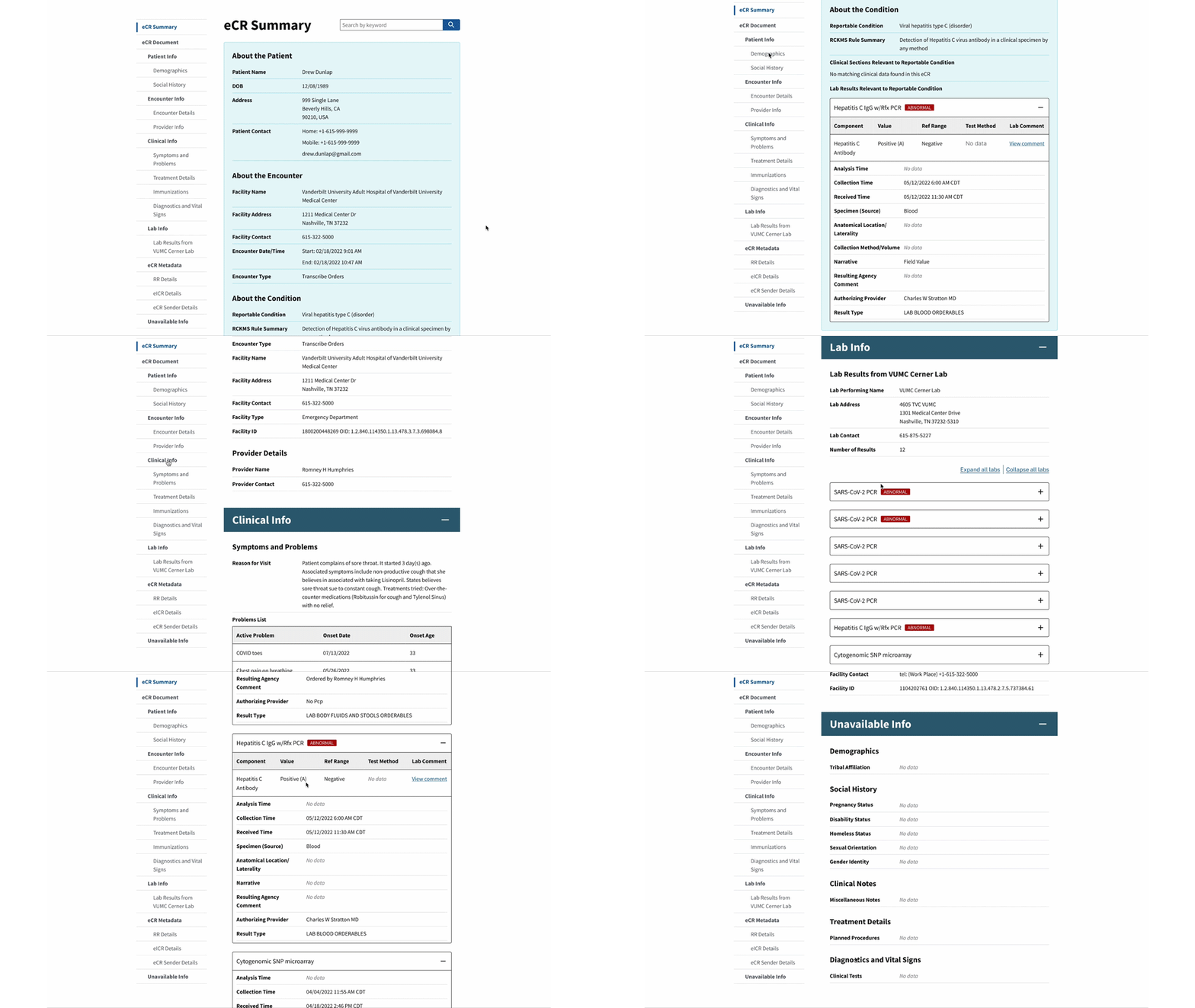
Skylight developed the eCR Viewer as part of a multi-year CDC and USDS initiative focused on pandemic readiness and interoperability. The tool surfaces a summary of condition-specific information in a readable format at the top of each eCR file, so staff can quickly find what’s relevant to the reportable condition. It also orders and organizes data consistently regardless of which electronic medical record system generated the eCR. The result: clinical information for case investigation becomes much easier to find, reducing the need to manually contact healthcare providers.
Discovery research with public health staff produced a clear design principle: surface the right information first. The core problem wasn’t the volume of eCR data itself. It was that condition-relevant information was buried deep inside each file with no consistent structure. That insight drove the eCR Viewer’s central design decision: present a condition-specific summary at the top of every eCR in a readable, consistent format. The team tested concept designs with users, iterated toward a lightweight minimum viable product (MVP), and established a measurement plan to validate time savings and adoption impact.
Rather than building a standalone tool, the team embedded the eCR Viewer into CDC’s existing surveillance infrastructure. We partnered with General Dynamics Information Technology (GDIT) to integrate the eCR Viewer into CDC’s National Electronic Disease Surveillance System (NEDSS) Base System (NBS) with pilot jurisdictions, including the states of Maine and Tennessee. We also established a separate pilot with the city of Philadelphia to evaluate the eCR Viewer as a web-based tool hosted by CDC outside of a surveillance system. The two pilots together tested whether the approach could work across different deployment models.
Initial results from our research efforts have been promising:
It is incredibly challenging to show and teach and get end users to use eCR when you can’t view all the data. This viewer will be absolutely a game changer to get people to understand the value of eCR.
Epidemiologist
Pilots started in summer 2024 to test the eCR Viewer in production data environments and further validate downstream public health impact. The aim is to scale across a wide range of jurisdictions and turn eCR into the go-to data source for case ascertainment and investigation. The eCR Viewer isn’t a standalone product. It works in concert with a wider portfolio of open-source, modular tools that together enable jurisdictions to build flexible, modern data systems.
The results
- Completed design and development of an eCR Viewer MVP and validated its potential time savings with public health staff
- eCR processing reduced from 25 clicks to 5 clicks — based on user testing with a lightweight MVP, the eCR Viewer enables staff to process a singular eCR file for case ascertainment in five clicks rather than twenty-five clicks
- Queue processing time reduced from 4.5 months to one week — based on user journey mapping in Maine, the eCR Viewer enables staff to process all eCR files in a queue (over 5,000) in just one week rather than 4.5 months
- Three pilot jurisdictions committed to testing the eCR Viewer in production environments, with kickoff starting in summer 2024