Redefining how government procures software
Summary
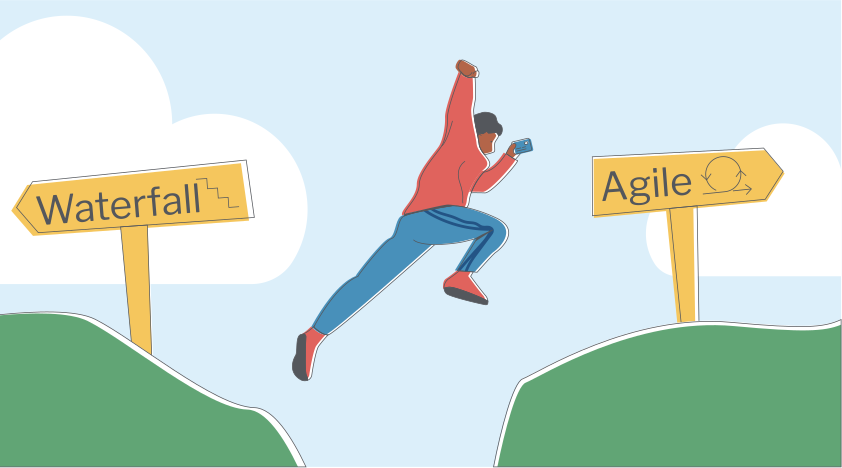
Before founding Skylight, Chris Cairns and Robert Read created the Agile Acquisition Framework — a new model for aligning how government procures software with how modern software is actually built. The framework was applied to more than a dozen federal, state, and local programs. Its influence extended well beyond those engagements, shaping how agencies across government approach software procurement to this day.
The challenge
Traditional government procurement was designed for large, predictable projects — multiyear contracts scoped upfront, evaluated on the strength of written proposals. That worked when requirements were stable. It didn’t work for software, where the most important decisions emerge through iteration and user feedback.
The mismatch showed up everywhere. Agencies couldn’t evaluate whether a vendor could actually deliver agile software — only whether they could describe it convincingly in a proposal. Requirements locked in at the start of a contract couldn’t adapt as user needs evolved. By the time working software was delivered — if it was delivered — it often no longer matched what users needed.
The result was billions of dollars in failed or underperforming technology investments. But the problem wasn’t that agencies wanted to keep doing things the old way. There was simply no proven approach for how to run an agile acquisition within government — from market research through evaluation, award, and delivery.
The solution
Chris and Robert designed the Agile Acquisition Framework as a modern playbook for software procurement, covering everything from market research through evaluation, award, and delivery.
The most fundamental change: replace written proposals with working prototypes. Traditional procurements rewarded the best writers, not the best builders. A “show, don’t tell” approach gave agencies real evidence of delivery skill before awarding a contract. This single shift addressed the root cause of most procurement failures — agencies couldn’t tell who could actually build software until it was too late.
Changing the evaluation wasn’t enough. The framework also had to change what happened after the award. It wove user-centered design, agile development, and modular contracting into a single acquisition life cycle. The way agencies bought software now aligned with the way it should be built. Evaluation criteria were tied to real user needs rather than abstract requirements, and contracts were structured to allow scope to evolve through iteration rather than locking everything in upfront.
Theory had to survive contact with a dozen real procurements. Engagements spanned Treasury’s Digital Accountability and Transparency Act (DATA Act), the Department of Defense’s (DoD’s) Military OneSource, the Social Security Administration’s (SSA’s) Disability Claims Processing System, the Environmental Protection Agency’s (EPA’s) Electronic Manifest System, the Navy’s Ready-2-Serve, and California’s Child Welfare System. In each engagement, Chris and Robert coached agency teams to run agile acquisitions independently — building capability rather than creating dependency.
The results
- Adopted by more than a dozen federal, state, and local programs
- Helped agencies avoid hundreds of millions of dollars in unnecessary technology acquisition costs
- Applied to major initiatives spanning Treasury, DoD, SSA, EPA, Navy, and California’s Child Welfare System
- Established a replicable model for agile procurement that continues to influence how software is acquired across government